-
pilhofer I actually agree with Ben T on a number of pieces but I think both his and the NYT piece over-index badly on their on personal assumptions. Yes, this is an indicator for what he calls Faceless publishers, and yes, aggregation instead of ad systems is a bad focus for regulation...Permalink On twitter.com
 ❤️ 2 Favorites
Mood -3 🙁
❤️ 2 Favorites
Mood -3 🙁
-
pilhofer Like, I think his Better Approaches section is 100% on point. But I think Ben T has some incorrect assumptions about how media reacts to social. It is deformed by it, neither its dependence for traffic or some sort of link tax is going to impact its editorial....Permalink On twitter.com
❤️ 3 Favorites
Mood +2 🙂
-
pilhofer The Ben T take amplifies the Big Conspiracy Theory in SV, which is that all criticism of tech is just a way for publishers to make money and I find that highly irresponsible. This is the fundamental frame I see informing the piece and it is a *bad* one.Permalink On twitter.com
❤️ 6 Favorites
Mood -9 🙁
-
pilhofer I also think Ben S and Ben T both overindex on the idea that governments acting against big tech do so only on behalf of publishers. I don't think regulators are stepping in to save publishers just as pressure from publishers is less effective on politics than ever...Permalink On twitter.com
❤️ 3 Favorites
Mood +4 🙂
-
pilhofer Like... it's been very clear in these discussions, especially the Australian and French examples, that the place this regulation comes from is that countries see both FB and Google as threats to State Power, and legitimately so.Permalink On twitter.com
♻️ 1 Retweets
❤️ 2 Favorites
Mood +1 🙂
-
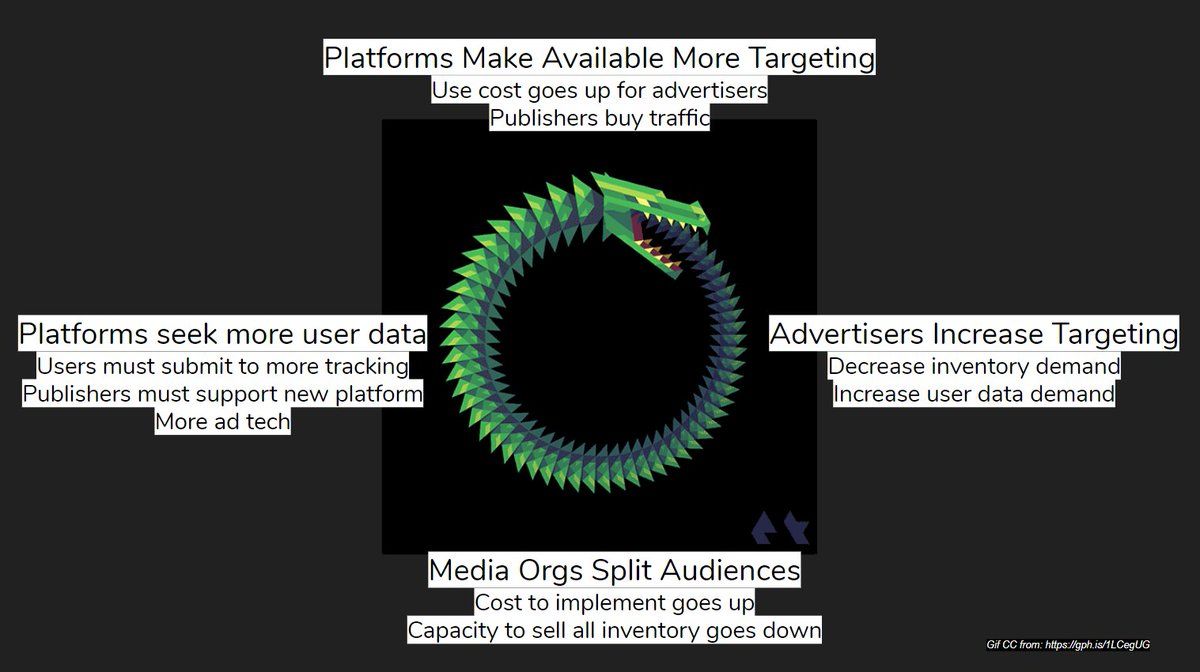
pilhofer But Ben T is right and Ben S is wrong about one major thing: a link tax does nothing to impact the actual cycle that gives power to Big Tech, because that cycle is user targeting and ad tech. There's no solution anywhere else...Permalink On twitter.com
♻️ 1 Retweets
❤️ 3 Favorites
Mood -1 🙁
-
pilhofer That is a question that is *different* from distribution as a question. Something like Google re-hosting AMP has huge advantages for publishers on a technical level in seeking performance, but it also incurs multiple costs.Permalink On twitter.com
❤️ 1 Favorite
Mood +5 🙂
-
pilhofer This is just one example. Being a web publisher is like being a citizen of multiple countries. These countries give you "free services" like traffic, but that is because they tax you elsewhere. Ben T approaches traffic publishers get from social platforms as if it was *free*...Permalink On twitter.com
❤️ 1 Favorite
Mood +6 🙂
-
pilhofer But it just isn't. There are huge expenditures for complying with the requirements of a platform like Google... even before we get to talking about buying traffic, which *every* publisher does...Permalink On twitter.com
♻️ 1 Retweets
❤️ 1 Favorite
Mood +3 🙂
-
pilhofer Google and FB both know this *very* well b/c they are known to pay big publishers to adopt new things like Facebook's Video platform...Permalink On twitter.com
♻️ 1 Retweets
❤️ 1 Favorite
Mood +3 🙂
-
pilhofer The problem is two-fold if you're paying for the NHS in the UK, there's transparency to the value of your payment and where it goes. But publishers pay big and have no idea how it impacts their effectiveness on zero-transparency algorithms...Permalink On twitter.com
❤️ 1 Favorite
Mood -1 🙁
-
pilhofer But the other part of the problem is that FB & Google *do already pay publishers* in free ad space, in adoption, in traffic exchange and in volume discounts for large publishers. Which means they are *literally* picking winners and losers.Permalink On twitter.com
♻️ 1 Retweets
❤️ 1 Favorite
Mood -2 🙁
-
pilhofer More than that, it makes disruption of large publishers by small or new publishers impossible, because big tech consistently reinforces the existing publisher power-structure.Permalink On twitter.com
♻️ 1 Retweets
❤️ 1 Favorite
Mood -1 🙁
-
pilhofer Like, this sort of behavior totally is a deformation of the news biz enabled purely by FB/Goog: vinnysgreen/1261301623222964225Permalink On twitter.com
❤️ 3 Favorites
Mood +2 🙂
-
pilhofer But I don't think the link tax is going to help small publishers as I understand how states are approaching it. It shouldn't be that direct anyway. It's still defined by the imbalanced way Google or FB can pick winners or losers.Permalink On twitter.com
❤️ 3 Favorites
Mood +2 🙂
-
pilhofer But it does hit on a problem Ben T does not touch on: which is publishers pay what is essentially a huge tax to big platforms, in a way that they usually would only do to the state, in compliance & direct costs; but they get none of the transparency a tax would normally bring.Permalink On twitter.com
♻️ 1 Retweets
❤️ 1 Favorite
Mood -1 🙁
-
pilhofer The other problem isn't just that publishers must pay money to FB/Goog. It's that paying money and technical compliance is the *only* way to interact with these platforms for most pubs. There is no platform-level regulatory body that separates good from bad actors effectively.Permalink On twitter.com
❤️ 1 Favorite
Mood -2 🙁
-
pilhofer If big tech is going to require compliance but not use that compliance to self-regulate an engine that can topple politicians, then the regulations on Big Tech that are coming really have nothing to do with publishers, it has to do with threats to state power.Permalink On twitter.com
❤️ 2 Favorites
Mood 0
-
pilhofer Ben S. centers this story on publishers. The story of compliance is then interpreted as gov't running to the defense of publishers or publishers pushing gov't to defend them. But publishers are just a useful counterbalance for gov'ts that see peer systems being literally toppled.Permalink On twitter.com
❤️ 2 Favorites
Mood +2 🙂
-
pilhofer Gov'ts are def taking the wrong approach tho. The idea is that FB can somehow deprogram its users by promoting legit publishers through money or tools is false. The problem is user-based ad targeting on those platforms, the 'free' traffic is irrelevant to all these problems.On twitter.com
❤️ 1 Favorite
Mood -6 🙁
-
pilhofer This cycle is the core issue, link taxes are irrelevant in the face of the cycle of ad tech user targeting.Permalink On twitter.com
 ❤️ 1 Favorite
Mood 0
❤️ 1 Favorite
Mood 0